Tips for Cutting Straight Lines with a Garden Saw
Disclosure: We may earn a commission when you buy through links on this page, at no extra cost to you. As an Amazon Associate I earn from qualifying purchases. Learn more

Tips for cutting straight lines with a garden saw: mark all around, line up your body and start with a shallow groove.
If you want tips for cutting straight lines with a garden saw, the secret is not a steadier hand, it is a better setup: a clear guide line, a saw that is held in one plane, and a start that lets the blade settle into its groove. Garden saws have thin blades that wander easily, so a little preparation pays off on every cut.
This page is about keeping a cut straight over its whole length, such as trimming a fence board, squaring a post end or cutting a log into even rounds. For accuracy on a single careful cut, see how to make precise cuts with a garden saw, and for slanted work read about cutting at different angles.
Draw a Line You Can Follow on All Sides
A line that wraps around the wood gives you something to check from every direction. Use a square to carry the mark across the top and down both sides of a board or post, then join the lines.
On round wood such as a log or thick branch, wrap a piece of paper or a strip of tape around it with its edges matched, and mark along the edge. That gives you a true ring to follow all the way around. On bark, tape plus a marker is easier to see than pencil.
Stand Square to the Cut and Line Up Your Body
Your body position decides where the blade goes. Stand so your cutting arm, the saw and the line form a straight row, with your dominant eye directly above the blade.
Keep your elbow close to your side, not flared out, so the saw moves back and forth like a piston rather than swinging in an arc. A good check is to look down the back of the blade, along the spine, and see whether it matches the line. If it leans, correct it before the groove gets deep.
Start With a Clean, Shallow Groove
A straight line starts with the first inch. Rest the teeth on the waste side of the mark at the near corner, draw the saw back three or four times with almost no weight, then deepen the groove gradually.
Once the groove is about a quarter inch deep, tilt the saw down to cut across the full face, then rotate the cut to the far corner. Keep checking both the top and side lines. If the cut begins to drift, do not twist hard. Gently reposition the saw and guide it back, since sharp corrections leave a stepped edge.
Use a Guide or a Saw With a Stiff Blade
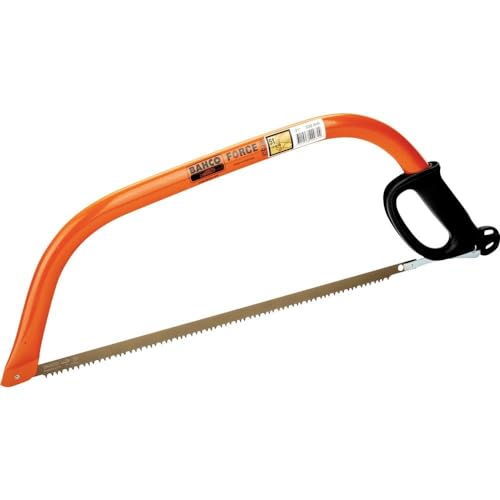
A block clamped along the line acts as a fence for the first few strokes, which is a simple help for new users. For long cuts, a bow saw is naturally straighter than a folding saw because its frame holds the blade in high tension.
The Bahco 30 inch Ergo bow saw for dry wood and lumber is a good example: it is listed as a 30 inch ergonomic bow saw for dry wood and lumber, and the larger frame tends to give steadier tracking. It is bulky for tight spaces, so skip it if you mostly trim small branches.

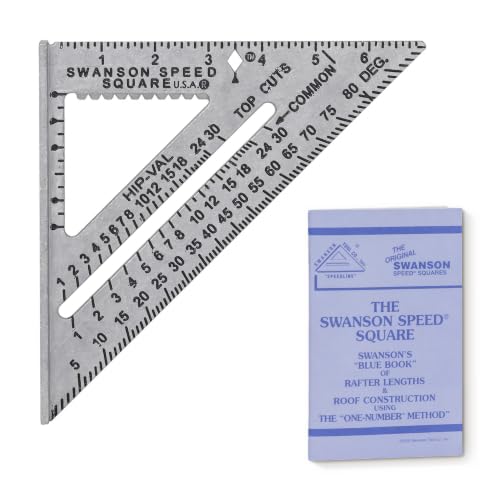
Swanson Speed Square: Best for Marking a Straight Line Across Wood
This aluminum layout square lets you draw a true 90 degree line from an edge, which gives you something to follow. It is a marking tool and does not guide the saw itself. Skip it if all your cuts are on irregular branches.

Let the Saw Do the Cutting, Not Your Arm
Pressing harder will not make the cut straighter. A dull or dirty blade leans, binds and skates, so keep the teeth sharp and free of sap. Learn how in how to maintain and sharpen your garden saw.
Use long, smooth strokes and rhythm. Take a break if your shoulder starts to ache, because tired arms drift off the line. For a step-by-step on cutting through mixed lumber, read how to cut through different types of wood with a garden saw.
Fix a Cut That Is Wandering
If the blade drifts off the line, stop. Back the saw up in the groove, rotate it slightly so the teeth point toward the line, and resume with light strokes. If the cut is badly off, start a fresh groove nearby instead of forcing the blade to bend.
For thick wood, flip it over and finish from the other side, following the line you marked there. Two matching cuts meeting in the middle are usually straighter than one long cut.
Straight Cuts on Round Logs and Branches
Round wood has no flat face, which makes it harder to keep a cut square to the length. Rotate the log if you can, cutting a groove all the way around the line before you saw through.
Scoring a ring around the log, about an eighth of an inch deep, creates a track that the blade follows for the rest of the cut. Then saw down through the groove, keeping the blade level with the ring you marked. This is especially useful for firewood rounds and fence post tops, where a clean flat end looks neat and sheds water.
If your cuts keep coming out slanted, look at the way you stand. A tilt of just a few degrees at the start becomes a visible slope by the end of the stroke. For more help with posture, see how to use a garden saw properly.
Checking Your Cut as You Go
Do not wait until the cut is finished to find out it is crooked. Stop after the first inch and look at the groove from above and from the side, comparing it to your line on each face of the wood.
At the halfway point, pause again and sight along the blade to see whether it still matches the mark. A quick check takes seconds and gives you a chance to correct a small drift before it becomes a large one. When the cut is complete, hold a square against the end to confirm it is true, and note what your saw tends to do so you can compensate on the next one.
For very long cuts, such as ripping a board down its length, a hand saw is the wrong tool, and a purpose-made rip saw or a powered saw will stay straighter. A garden saw is best for crosscuts and trimming, which is where most yard work happens.
FAQ: Tips for Cutting Straight Lines with a Garden Saw
Why does my garden saw cut crooked?
Usually because the blade is dull, the pressure is too heavy, or your body is not aligned with the line. Fix these three and the cut generally straightens out.
What saw cuts the straightest line?
A bow saw or a fixed blade pull saw tends to track straighter than a flexible folding saw, thanks to blade tension or a stiffer spine.
How do I keep a cut straight on a round log?
Wrap paper or tape around the log, mark along its edge to get a true ring, and follow that ring on all sides as you cut.
Can I use a guide block?
Yes. A clamped block along the line keeps the first strokes on track, which is where most straight cuts are won or lost.
To recap these tips for cutting straight lines with a garden saw: mark all around the wood, line up your body, start with a shallow groove, and use light strokes with a sharp blade. A calm rhythm gives straight results every time.